Guide
Driveway materials, explained
The two materials
Both go down the same way. They wear nothing like each other.
- Crushed shellseashell drivewayclam shell driveway
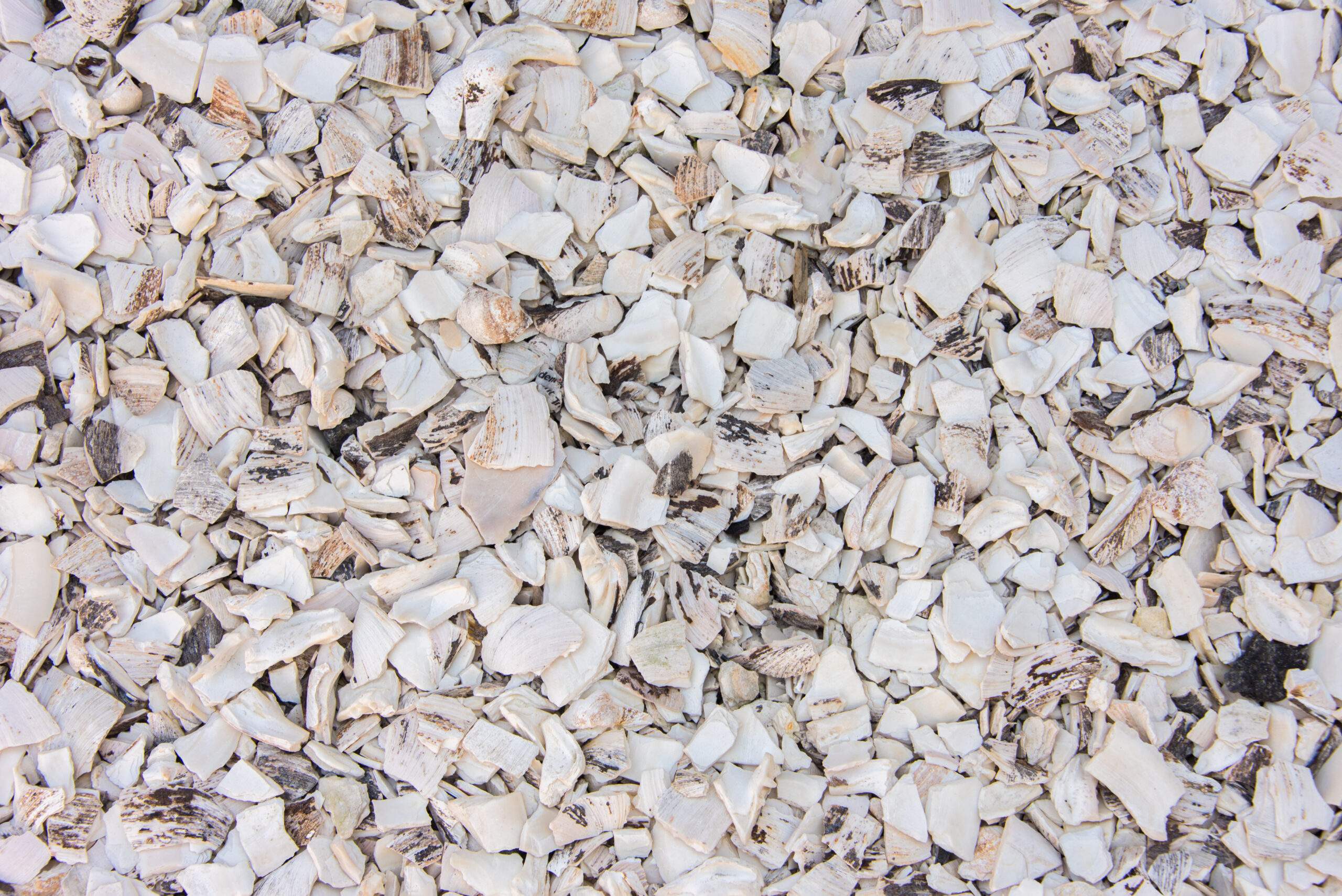
- Broken clam, quahog, oyster and scallop shell, crushed to a driveway grade. It turns up gray, and coarser than you'd expect. A few sunny days later it's white.That gray is the most common first week phone call we get. Nothing has gone wrong. Nobody sent the wrong load.
- Crushed stone
- Angular crushed rock, used as the wearing surface instead of shell. It doesn't break down the way shell does, so it stays the size it arrived at.
- Angular
- Stone with broken faces rather than rounded ones. The flat faces bite against each other and the surface locks up.It's why crushed stone holds a slope and why rounded material rolls out from under you.
- Fines
- The dust and small fragments mixed into any crushed material. Not a defect. Not filler.Fines wash down into the gaps between the bigger pieces, and they're the only reason a loose surface compacts at all. Material washed clean of its fines never knits together.
Sizes, and what they mean underfoot
The number is less exact than it sounds. And the difference you actually feel is not the one people expect.
- Three quarter inch3/4"three quarter
- The size we install for crushed stone. Small enough to walk and drive on comfortably, large enough that the pieces lock against each other instead of rolling apart.
- Three eighths inch3/8"three eighths
- About half the size. Finer underfoot, and it packs tighter. But small material travels, and it ends up in the lawn and indoors on your shoes.
- What the number actually describes
- It's the screen the material passed through. So it describes the biggest pieces in the pile, not every piece in it.People think they've been sold the wrong thing when a three quarter inch load turns up full of smaller material and dust. That mix is the product working.
What is underneath
Most of the money and nearly all of the lifespan sit below the part you can see. This is the vocabulary that decides whether a driveway lasts.
- Basesub-base
- The compacted layer of material between the ground and the surface you walk on. It spreads the weight of a car across the soft ground underneath.Skip it and the shell presses down into the soil. The depth you paid for is gone in a season.
- Lift
- One layer of material, laid and compacted before the next goes on top. Three inches of shell goes down in two lifts, not one.A compactor only reaches so far down. Dump the same three inches in one pass and the middle stays loose, and a loose middle is where ruts start.
- Compaction
- Driving the air out of a layer with a plate or roller so the pieces settle against each other and stop moving.
- Crown
- The slight rise along the center line of a driveway, so the surface falls away to both sides.Water that can't get off the driveway goes down into the base instead. A soft base is how a loose surface fails.
- Pitchfallgrade
- The slope along the length of the driveway, which decides where water ends up.Pitch that sends run-off at a garage door or a foundation is a problem no amount of surface material fixes. Get it wrong and you are regrading, not topping up.
Edges and ends
A loose surface spreads sideways unless something stops it. What goes at the boundary matters as much as what goes on top.
- Edging
- Anything run along the side of the driveway to hold the surface in: granite cobble, brick, timber or a cut edge against turf.Edging is the difference between topping up every few years and picking shell out of the grass after every mow.
- Apron
- The first few feet of driveway where it meets the street.It takes the hardest wear on the driveway. Every car turns across it, and the plow hits it first.
How it is sold and measured
Quotes switch between volume and weight without warning. It makes two prices look comparable when they aren't.
- Cubic yardyard
- A volume. A cube three feet on each side. Crushed shell on the Cape is sold this way.
- Ton
- A weight. Crushed stone is sold this way.You can't put a price per yard next to a price per ton and call it a comparison. How many tons sit in a yard depends on the material and how wet it is, so any conversion is an estimate.
- Coverage
- How far a given quantity goes, which depends entirely on the depth it is spread at. The same load covers three times the area at one inch that it does at three.A quantity quoted without a depth beside it tells you nothing.
Upkeep words
What gets quoted when a driveway already exists and needs attention rather than replacing.
- Top-offrefreshreplenishmenta fresh layer
- Fresh material over an existing driveway that has thinned out, to bring the depth and the color back.Most driveways with a sound base don't need rebuilding. Topping off costs a fraction of starting again.
- Regrading
- Reworking the shape of the surface before new material goes on, so the crown and pitch are right again.New material over a surface that already holds water just buries the problem.
- Migration
- Loose material working its way off the driveway. Toward the edges, down to the street, or wherever cars turn hardest.
Get an estimate
Still not sure what you need?
Tell us the town and roughly how big the driveway is. We will come and walk it rather than quote off a satellite photo, and tell you straight whether it needs doing at all.
- Free, with no obligation after
- We look at the base, not just the surface
- Across Bourne to Orleans